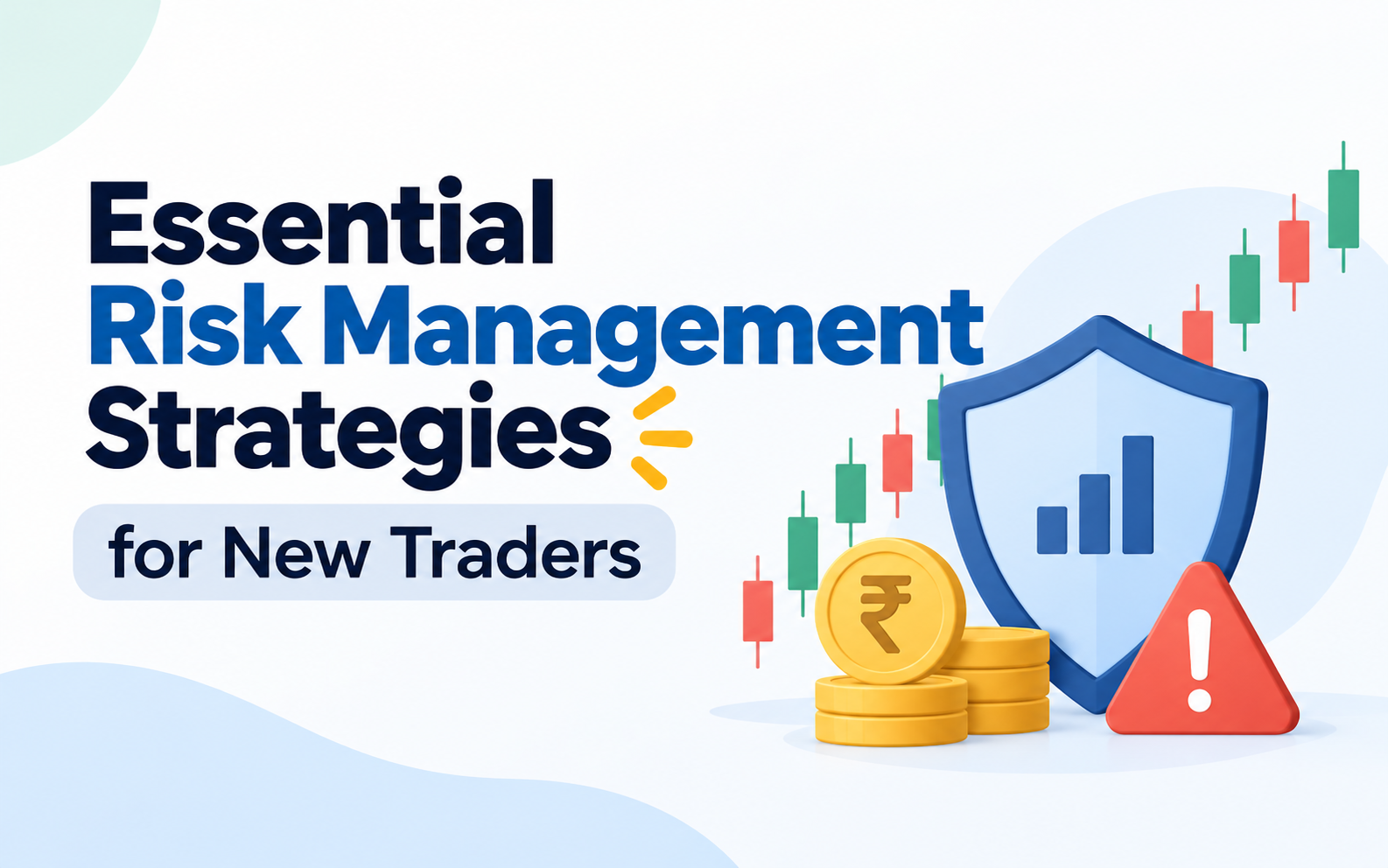
Essential Risk Management Strategies for New Traders
Before thinking about how much you could earn, decide how much you can afford to lose. Learn practical ways to protect your capital, control trading decisions and avoid costly mistakes.
Imagine making a good trade in the morning and losing the entire profit on an impulsive decision in the afternoon. For new traders, situations like this can be frustrating. A risk management plan helps you decide what to do before emotions take over.
Trading involves uncertainty. A stock, currency pair or other financial instrument can move against your expectations even after careful research. Risk management cannot guarantee profits, but it can help you limit exposure and make decisions more consistently.
Think of your trading account as a control room. Every position has a size, every trade has a possible loss, and every decision should follow rules you have already considered. Here is how to build that system.
Inside the trader's risk control room
Your trading risk dashboard
PLANNING MODEThis is a planning framework, not a live market dashboard. Its purpose is to remind you that each trade should have clear limits before money is committed.
01. Set a loss limit before chasing a profit
New traders often focus on the possible upside of a trade. They may imagine how much they could earn if the price rises, while giving little thought to what happens if it falls.
Start by deciding the maximum amount you are willing to lose on a single trade. Some traders use a small percentage of their account as a planning guideline, often around 0.5% to 1%, but no percentage is universally safe or appropriate for everyone.
For example, if your trading capital is ₹50,000 and you choose to risk 1% on a trade, your planned loss limit is ₹500. This does not mean the loss is guaranteed to stay within ₹500. Gaps, slippage and execution problems can cause the actual loss to be higher.
Risk rule
Never use money needed for rent, household expenses, education, emergency savings or loan payments as speculative trading capital. Consider whether you can afford to lose the entire amount allocated to trading.
02. Calculate position size instead of guessing
Position sizing determines how many shares, units or contracts you buy or sell. It should reflect the distance between your entry price and your planned stop-loss level, as well as your chosen monetary risk.
Suppose you have decided to risk ₹500 on a trade. Your planned entry price is ₹200 per share and your stop-loss is ₹195. The planned loss per share is ₹5, before costs and slippage.
A simple position-sizing example
| Item | Amount |
|---|---|
| Trading capital | ₹50,000 |
| Planned risk | ₹500 |
| Entry price | ₹200 |
| Stop-loss price | ₹195 |
| Planned risk per share | ₹5 |
| Calculated quantity | 100 shares |
Calculation: ₹500 ÷ ₹5 = 100 shares. The position would cost ₹20,000 before charges. If the stop executes at ₹195, the planned price loss is ₹500, excluding costs and any execution difference.
For derivatives, forex or leveraged products, contract multipliers, margin requirements and price movements need additional calculations. Never assume the share-based formula applies directly to every instrument.
03. Use stop-loss orders thoughtfully
A stop-loss is an exit instruction designed to help limit a trade's downside if the market moves against you. It should be placed at a level that makes sense for the strategy, then used to calculate the position size.
Placing a stop extremely close to the entry price just to increase position size can lead to frequent exits from normal price fluctuations. Placing it too far away may create a loss that exceeds your intended budget.
Learn how your broker handles stop-market and stop-limit orders. A stop-market order may execute at a different price during a fast move, while a stop-limit order may not execute at all if the market moves beyond its limit.
Watch out for stop-loss myths
A stop-loss is a risk-control tool, not a guarantee of a specific exit price. Market gaps, low liquidity and sudden volatility can affect execution.
04. Understand risk-to-reward before entering
The risk-to-reward ratio compares the amount you plan to lose if a trade fails with the amount you hope to gain if it succeeds.
Suppose your planned stop-loss represents a ₹500 loss and your target represents a ₹1,000 gain. The potential reward is twice the planned risk, giving a 1:2 risk-to-reward ratio.
That ratio alone does not make the trade good. Your strategy's win rate, transaction costs, slippage and the likelihood of reaching the target also matter. A high reward target is not useful if it is unrealistic for the market conditions.
Evaluate the setup as a whole rather than choosing a trade simply because its ratio looks attractive.
05. Know when to stay out of the market
Sometimes the best risk decision is to skip a trade. A market may be unusually volatile, a major announcement may be approaching, or the price action may not match your strategy.
Decide in advance what conditions would make you avoid trading. These might include a wide bid-ask spread, poor liquidity, an unclear stop level or a lack of a valid setup.
Do not enter a trade simply because you are bored or feel that you must make money every day. Cash is also a position, and waiting can be a reasonable choice.
06. Protect yourself from leverage
Leverage allows a trader to control a position larger than the cash committed to it. This can magnify gains, but it also magnifies losses and can trigger margin calls or forced liquidation.
Before using leverage, understand the product's margin rules, contract size, financing costs and liquidation conditions. Calculate the possible loss under an adverse price move rather than judging risk by the initial margin alone.
New traders should learn how an instrument behaves without taking on more exposure than they can financially tolerate. Leverage does not turn a weak trading setup into a strong one.
07. Diversify your exposure
Opening several positions does not necessarily reduce risk. If those positions depend on the same market factor, they may all lose money together.
For example, several technology shares may react similarly to a sector-wide decline. Holding different tickers can create the appearance of diversification while leaving the portfolio exposed to the same underlying risk.
Review the combined exposure of your positions, including correlated assets and leveraged trades. Set an overall portfolio risk limit and consider whether one market event could affect several positions at once.
08. Control revenge trading and overconfidence
A loss can trigger an urge to recover the money immediately. After a profitable streak, a trader may also become overconfident and increase position sizes without a sound reason.
Both reactions can lead to decisions outside the original plan. Set a daily loss limit or a rule that requires you to stop trading after a specified number of poor decisions. Take a break when you feel angry, rushed or unusually excited.
Do not increase your position just to recover a previous loss. Each new trade should be evaluated on its own merits, with the same risk controls you would use after a winning trade.
09. Keep a trading journal
A trading journal helps you see whether your process is working over time. Record the reason for each trade, entry and exit levels, planned risk, actual result, transaction costs and whether you followed your rules.
After a meaningful sample of trades, review your results. You may discover that losses cluster around certain market conditions or that you repeatedly exit profitable positions too early.
Look at performance across many trades instead of changing your strategy after one bad result. A journal is most useful when it records your actual decisions honestly, including mistakes.
10. Test your strategy before increasing exposure
Before committing significant capital, study how your strategy would have performed in historical market conditions. Backtesting can reveal weaknesses, although historical results do not predict future performance and may be affected by data quality, transaction costs or overfitting.
Paper trading can help you practise order placement and follow your rules without risking real money. It does not fully reproduce the emotions, liquidity or execution conditions of live trading.
If you later move to live trading, begin cautiously and evaluate whether actual results match your expectations before considering any increase in exposure.
Your pre-trade risk checklist
Review these points before placing your next trade. Tick each item as you check it.
Frequently asked questions
What is risk management in trading?
Risk management is the process of identifying, measuring and controlling potential losses. It includes position sizing, stop-loss planning, exposure limits and monitoring trading behaviour.
How much should a beginner risk per trade?
There is no universally suitable amount. Some educational frameworks use a small fraction of account equity as a planning guideline. The appropriate limit depends on your financial situation, strategy, instrument and ability to absorb losses.
Can stop-loss orders prevent all trading losses?
No. Stop-loss orders can help manage downside, but execution prices can differ from the trigger price and some stop-limit orders may not execute.
Is a higher risk-to-reward ratio always better?
No. A target that is too ambitious may rarely be reached. The ratio must be evaluated alongside the strategy's win rate, costs and realistic market behaviour.
Protect the capital you have before planning the capital you want
Trading outcomes are uncertain, and even a carefully planned trade can lose money. Build a repeatable process, size positions responsibly and review your decisions over time. Risk management cannot eliminate losses, but it can help you approach trading with clearer limits and fewer impulsive decisions.
Disclaimer: This article is for educational purposes only and is not financial or investment advice. Trading, particularly leveraged derivatives, can result in substantial losses. Consider your financial circumstances and seek advice from a qualified professional where appropriate.